2024-03-26
“What in sweet loving— what is that?!” I say, jumping to my feet.
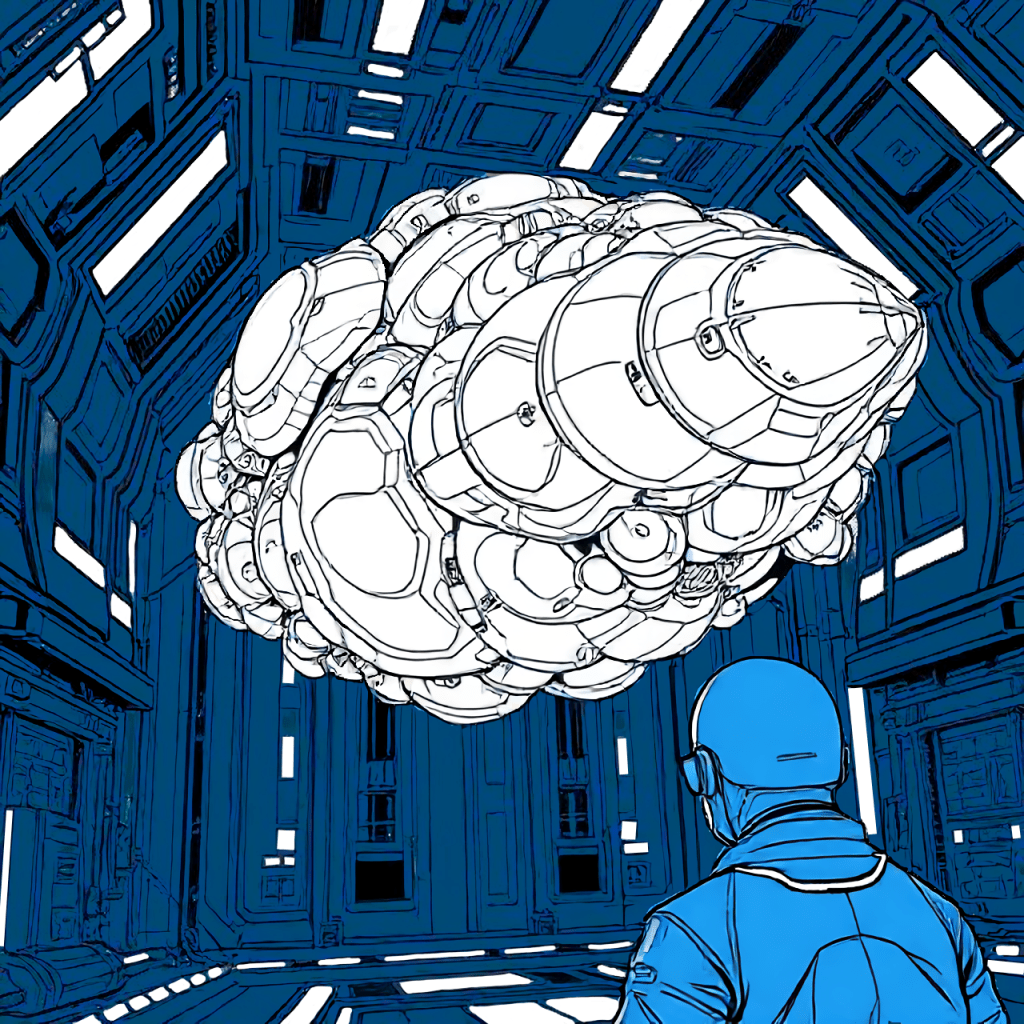
The words are pulled from me, drawn out by the twisted and bloated mess of metal and desiccated flesh being towed into my bay. I pick up the comm.
“T’lignerion Bonerforti Ucherish, don’t you dare tell me that’s a ship,” I utter down the line, “Or I’ll cut you.”
“J’eriliel Khalimeri Ghorion, you’d have to find me first. And I’m on leave in ten minutes, so—”
I curse.
“So this monster is…” I manage.
A laugh.
“Yep. All yours, buddy.”
The bulk is even more intimidating up close through the remote. Tissue and synthetic materials have grown around each other in a chaotic medly. In one section the parts twist out like a corkscrew, while in another they form a dappled painting and in a third they form repeating patterns. In most cases, vacuum tolerant tissues were forgone, and sensitive tissues were instead exposed. These have set into a dry and lifeless crust.
The worst cancer I’d ever seen.
I cue the documentation and roll it past. The lump was hauled in by a passing freighter, off the edge of a backwater, and has no clear matches nothing in profile or location. The freighter deemed it non-reactive, but as a precaution, I initiate detachment. My whole bay judders briefly, then is released from the rotating mass of the greater station, two hundred times larger. At a safe distance, another jolt indicates braking, and we fall into stable orbit around the local star.
Time to begin.
I set a series of emitters and detectors to sweep around the bulk and determine the internal structure. As they run, I deploy a series of micro-, nano- and picoscopes to analyse the surface. More crudely, I select a patch of dead tissue and takes a series of samples.
The scans finish and I display the model in front of me. Unforunately, the tissue is criss-crossed with bands of synthetics — metals, ceramics, plastics — and my image of the interior is unclear.
“Cassie, what do you think?” I concede.
“I was wondering when you’d give up,” a cool voice says.
I eye the woman and shrug.
“I can’t let you do everything.”
She nods, smiles, and examines the model. I know that somewhere, Emmanuelle is analysing the raw data. Cassie, her proxy, is mostly for my benefit.
“Probably the worst cancer I’ve ever seen,” she concludes, “I don’t like it.”
“I don’t either,” I say. “The tissue should never have grown like this. And I have no idea why the synthetics followed.”
I look at the cancer, sitting in my bay. At the moment, a series of tools are producing small bubbles of atmosphere around the tissue, removing dead flakes and searching for live cells. Equipment on the side of the room is extracting the nucleic acids, reading the sequences and epigenetic markers present.
“I can think of two possibilities,” Cassie says.
I make eye contact with her, and a chill raises bumps on my skin.
“You think this was an attack? A virus?”
She dips her head.
“But that’s the better outcome.”
“What’s worse than a virus that can produce that?” I point at the malformed lump.
“A mind who does that to itself, willingly.”
After this exchange, we halt while Emmanuelle analyses the genetics. If a virus were at play, we would find it. Genetic parasites are almost always of the same brood— A few genes produce a protein-based shell, while others serve to subvert the insides of cells. If we found any of genes, then it would suggest a virus was at play. Even better, if we could isolate a complete viral genome, we could model exactly how the disease took over to produce the thing in my bay.
“I bet you wished I didn’t take this job,” Emmanuelle says, breaking the silence.
“From the mouth itself,” I say, glaring at the nearest photosensor. “Yes, Emmanuelle, I’m upset. We’ve built some of the fittest and most beautiful things that have ever existed in this bay. And now…”
“And now, in their place is a tumour.”
I nod.
Cassie walks over and takes my hand.
“It’s okay, J’eri, nothing will go wrong.”
She reaches into the cabinet and pulls out an object. I blink, then laugh. It’s a big red button.
“What is that supposed to be?”
She laughs too.
“We cooked it up last night when we accepted the job. It’s exactly what it looks like. This office module is now self-sustaining. At the first sign of trouble we will drop the bay into the star and aim for the station.”
She places the big red button in front of me.
“The big red button doesn’t actually launch things, does it?” I say, eyeing the piece.
“Well,” Emmanuelle replies. “If there is a virus, and it were to escape, you serve as backup to me and Cassie.”
I look at the tumour in the bay.
“I— I’m both worried and glad that you’re taking this seriously,” I say.
Cassie nods, then tilts her head.
“Got it. We found a virus, and Emmanuelle is modelling it now.”
A thud pulses from the bay and a display is projected for my reference. A capsule is falling into the star below us.
“That bad?”
“Total takeover,” Emmanuelle replies. “This thing has every anti-defence I have on record, and a few anomolous genes that will need more modelling. Not an icecube’s chance in corona that it isn’t synthetic.”
“What about the rest of it?” I ask, “Apart from the antiviral counters.”
“Closest natural relative is a mimivirus. I’d guess the anomolous parts are— ah, they bind to DNA polymerase and seem to form a complex. Oh, that’s not good.”
“What?”
“This virus bypasses all standard internal immune defences, and the complex makes mutations…”
“Giving us the tumour we see here,” Cassie finishes, looking through the display at the lump.
I frown.
“Internal immune defences. What about the external ones? The scrubbers and hybrid adapative units that are supposed to kill infected tissue when it can’t kill itself?”
Cassie frowns, and Emmanuelle speaks.
“Let’s take a look.”
A drill pierces dead tissue and soon strike a surface vein. We withdraw the bit and scrape away the plasma, frozen and adherent to the metal. The analysis unit first thaws the blood, then isolates the immune cells.
“The plot thickens,” Cassie says, before forwarding the data to me.
The few uninfected cells — one in a billion — are apoptotic. Intentionally dead.
“So it turned them off?” I wonder aloud. “What is this? Suicide?”
Emmanuelle speaks, and Cassie’s face flushes.
“That’s the most likely option, but we shou— uh oh.”
“What? Tell me what’s wrong.”
“The cells have eaten at the seal, and have breached their initial container,” Emmanuelle says, after a moment. “I’ve flushed the system with redox, and it’s pushed them back, but I don’t know how long that will last. I’m weaving a larger containment around them now.”
“The cunning little stunts,” Cassie enunciates.
“Can you vent them?” I ask.
“I could, but then we could have a cloud of them floating here in orbit. I don’t want to clean that up.”
I look at the red button and raise an eyebrow, trying to ignore the twisting in my stomach.
“Not yet,” Cassie says, following my gaze. “We must uncover happened here before we kill it. In case there’s a next time.”
I look at her and shake my head.
“Emmanuelle, you can’t be serious. What would the next step even be?”
“I want to talk to it.”
“You what?!”
“Self-preservation is the fundamental principle of life. It’s why your genes and our ideas exist. Somewhere in that mess is a mind that disabled its immune systems and turned itself into a tumour, overriding that principle. I want to know why.”
I feel the muscles of the remote as though they are my own. They’re a custom design Emmanuelle produced, fully synthetic, but coated in a layer of cells that resemble those of the tumour. Beside me, Cassie-bot walks in step. Both of us are guided by Emmanuelle, allowing the use of her faster reactions.
“Best entry point is here,” Cassie-bot says, spraying a circle of red on the surface of the tumour.
I layer the model over my vision as we start cutting. This is where the synthetics are thinnest.
“The outer layers are dead, but what about deeper in? Are we expecting a response?” I ask as we cut. I reach a strip of synthetic and throw sparks outwards, searing flesh on my bot, inducing a recovery response. The tumour continues, sitting passive.
“I’m not sure,” Emmanuelle admits. “There’s little heat coming off of it, which is a good sign, but I can’t rule out a low-power synthetic device waiting inside.”
I imagine synthetic jaws and supress a shiver.
Two metres in, we strike a void and atmosphere rushes outwards. I curse, but a bubble is extended around us and the hole, catching the gas.
“High in oxygen, carbon oxides, and ammonia. A few other nasties, but it would be breathable for a few minutes. Just a hair above freezing,” Cassie-bot says
“I’m surprised it’s pressurised,” I say, shining a light in the hole.
“You and me both,” Cassie-bot replies, entering and pulling me after her.
Inside is the twisted remains of a corridor. Cream padding with conspicuous stitches and handles are standard, and remain in small patches. The rest, however, is a tangled harem of colour and texture. Hybrid tissues contort the corridor, giving only a few metres of visibility.
“J’eri, I’m seeing no response so far,” Emmanuelle says. “But we’re running out of time. The cells have figured out how to digest ceramics, and are working their way through the layers I’ve spun around containment, and I have no easy way to eject this. I’m not seeing a virtual attack yet, but— ah, there’s the first probe. Dumb, but it’ll get better, fast.”
I grimace and look at Cassie-bot.
“Let’s split up,” she says, before anchoring a signal cable on me.
I nod and throw one end of another signal cable out of the hole. On striking the bay floor, it self-sockets, and gives us a fixed link to Emmanuelle. Cassie-bot disappears behind flesh; I shrug and go the other way.
Navigating the corridor is tough work. Rings of tissue have constricted in places, narrowing the diameter, and requiring cutting tools to progress. All around the corridor, hundreds of smaller openings branch off, each too narrow to traverse, further narrowed by identical rings of tissue a short distance inside.
“Are you seeing these rings?” I ask, as I pass through a third.
“Yes, they’re making things difficult,” Cassie-bot replies through the cable. The layers of metal around us have made wireless comms impossible.
“What do you think they are? Was it trying to close things up? Remodel the basic structure of things?” I say, looking at the structure.
“Well, they—”
“Wait, I have it. They’re valves. It’s turned this corridor into a vein.”
“So it has. I wonder why?”
I shrug, knowing that the movement is communicated by the wire.
“Does this mean that there are arteries too?”
I feel a shrug come in return, but it cuts out halfway through.
I turn and run the way I came. A cut-off can mean only one thing.
“J’eri, what’s going on? I’ve lost signal with the bot,” Emmanuelle says directly.
“Finding out now. Are you watching my data packets?”
“Always.”
I squeeze through a narrow passage, pass the entrance hole, and follow the trail of datacable. It snakes through the cacophony of tissue, passing structures that are almost familiar. Then, I see it. One of the tissue rings has a sharp edge, and once constricted cleaved the cable. I start hacking and soon have a hole.
I reach through the portal, and seeing Cassie-bot on the other side, go to reattach the datacable.
Emmanuelle yells something vile and my bot-hand jerks the cable away.
“Don’t!” she says, before pausing. “Look closer.”
I do as she says, then curse.
The top half of the bot’s cells have been worn away, exposing the synthetic material underneath, which now collapses inwards.
I back away.
“Some of the cells were scraped off by that cutting edge, then something here detected the synthetics and deployed a counter,” Emmanuelle says. “I expected there would be defences inside. That was why I put mimic cells on the bots… But I have no idea how it detected the metal, or how it dissolved it. Especially in this low temperature.”
I nod.
“Can you send in—”
“Already here, J’eri-bot,” a second Cassie-bot says, attaching the datacable and patting my shoulder. “And here’s our sacrifice.”
The bot extracts a small orb, scratches off cells, and throws it through the hole. The orb sails through, then stops abruptly, and falls to the ground, half of it disintegrating.
Cassie-bot shines a narrow-spectrum light through the hole, and the dancing filigree of a fine net shines back.
“Filament. Probably enzyme-coated, ready to catch any synthetic larger than an apple and digest it.”
Cassie-bot widens the hole in the valve, then steps through and sears the net.
“Defences suggest we’re going somewhere important,” Cassie-bot says.
“The mind?”
“Most likely.”
Cassie-bot moves through the corridor and I follow a few metres behind. We encounter more nets, and Cassie-bot disarms them as she goes. The corridor changes as we move deeper, growing more chaotic. The cream padding is all gone, and more tissues are present, winding and whirling around each other in no clear pattern. We pass a collapsed valve, and all semblance of regular structure is gone.
“How is the, uh, leak?” I ask, after passing a tight section.
“There are full-on virtual attacks now. I thought about cutting off my sensors inside their lair, but then I won’t know how they’re progressing, so I’m just parrying attacks as they come. They’re clever, but not organised enough to be a threat.”
“Emmanuelle,” I say, uncertain of how to continue, “I—”
“It’s in hand, J’eri,” she replies. “It won’t threaten you or me, or Cassie. We’ll probably lose the bay, but that’s all, I promise.”
I start to voice a complaint.
“J’eri, come here.”
I frown and pass through a final constriction to enter a larger chamber. The walls, floor, and ceiling are more regular here, a consistent shade of red. The floor tapers away in one corner, and on the far side is the recognisible shape of a three-leaf valve.
“The heart,” I conclude, and Cassie-bot waves in agreement. I look back at our entryway,
“We’ve just come through a two-leaf valve, which means we’re in the…” I say, wracking my mind.
“Left ventricle. We’re going the right way, J’eri,” Cassie-bot trumpets, making for the exit.
She cuts through the three-way valve and continues. I resume my safe following distance, soon turning down a side-channel. The tissue here is even more chaotic, and difficult to traverse. Our progress slows to a crawl when Emmanuelle signals me, and Cassie starts cutting more aggressively.
“Time is tight. I’ve cut off my sensors—” Emmanuelle whispers, before pausing.
“Emmanuelle? Are you all right?” I ask, concern blooming in my chest.
“Yes, it’s just—” she says, before pausing. “That was the closest I’ve been to death. I think they’re growing neural tissue in there, now. Too damned clever.”
The tumour jolts around me.
“Emmanuelle—”
“My doing. I’ve sacrified half of the bay to make a larger container around them. I had to destroy the office, but don’t worry. You and Cassie are in suits in a closet.” Emmanuelle says.
“Is that going to be enough?” I ask, moving past an obstruction.
“Found it,” Cassie-bot calls. “Come over and see.”
I move forward and enter a chamber. Like a pile of mutant worms, layers of tissue form interconnected cords that branch and merge, surrounding a central object. The same shapes, but made of all other tissues, comprise the curved ceiling and walls, and the floor.
Cassie-bot walks forward and taps the central object.
“Here’s the mind, surrounded by neural tissue.”
A judder rolls through the floor and I look at Cassie-bot in alarm.
“Emmanuelle?”
“Just taking precautions, is all. You’re fine.”
I shake my bot-head and look at Cassie-bot, who is peeling away neural tissue.
“Help me with this, we need to find the crystallisation point.”
I nod and start cutting. Even frozen, the neural tissue is soft and peels away. Soon, we have part of the object exposed. It’s a black cylinder, a fourth-generation artificial mind.
I whistle, a noise more deftly controlled when coming through the bot. This is new mind, the generation only recently built. A mind that surpasses all those which came before. Cassie bot whistles in turn, acknowledging me.
I remove a strip of tissue and expose…
A face.
“Emmanuelle! Cassie!” I yell, but Cassie-bot is already here.
Together we strip away the neural tissue, and pull out the man’s body. Doing so exposes the crystallisation point, which has been stabbed by a tool that falls from the man’s hand.
Emmanuelle curses something vile, then does it again.
“What?” I ask, then, continuie in suspicion, “Emmanuelle. What are you hiding from me?”
“I’ve already pushed the big red button.”
“What?!”
“I’m sorry, J’eri, I couldn’t risk it any longer. You, Cassie, and I are crammed aboard our closet with an EM beacon. I kept the line to the bots open so that we get as much data as possible. But—”
“What did you expect to find?”
“Well, not him, for starters. And I didn’t expect the crystallisation point to be broken either. We won’t be able to pull anything out of them now, and we don’t have the time or ability to get them away from here.”
“Emmanuelle,” I enunciate clearly. “What is this all about?”
“There is a defect in fourth generation minds. A few have just— fallen apart. Driven themselves into stars, blown themselves up, dissolved into cancers that digest everything into nothing—”
“But this one hasn’t,” I finish bitterly. “Because he got to it first. But you didn’t know that when you set the bay to fall into the star. So we have no way of getting him out.”
The signal cuts out, and I’m back in my real body. I’m in a suit, pressed tight against Cassie, who looks at me through our visors. I glare at her then roll my eyes.
“Emmanuelle. We have no way of getting him out, right?”
Silence.
I sigh and access the outside sensors. The glare of the star is immense, but with enough filtering I can see the bay on its way to the inferno. I set a regular ping for the bots and remain silent.
After some time, I get two signals on my ping.
One set of pulses quicken, while the other set lengthens.
The bay disappears below the photosphere and beyond the simple instruments at hand. At the same time, the second ping gives out. With a thud, something impacts the closet. I request input from the relevant sensors, but am denied.
“Emmanuelle, how strong was that datacable?” I ask.
Neutral in tone, she replies: “Strong.”
“Strong enough for one bot to use it to launch the other?”
A pause.
“Yes, and a little more.”
“Emmanuelle.”
“Yes, J’eri?”
“If that little more is a human brain…” I trail away.
“J’eri?”
“I want a much larger bay. And I want out of this conspiracy.”
The barest of pauses pass, and Cassie takes my hand.
“Or a divorce.”
She squeezes.
 TCDH
TCDH 
Leave a comment