2025-01-01
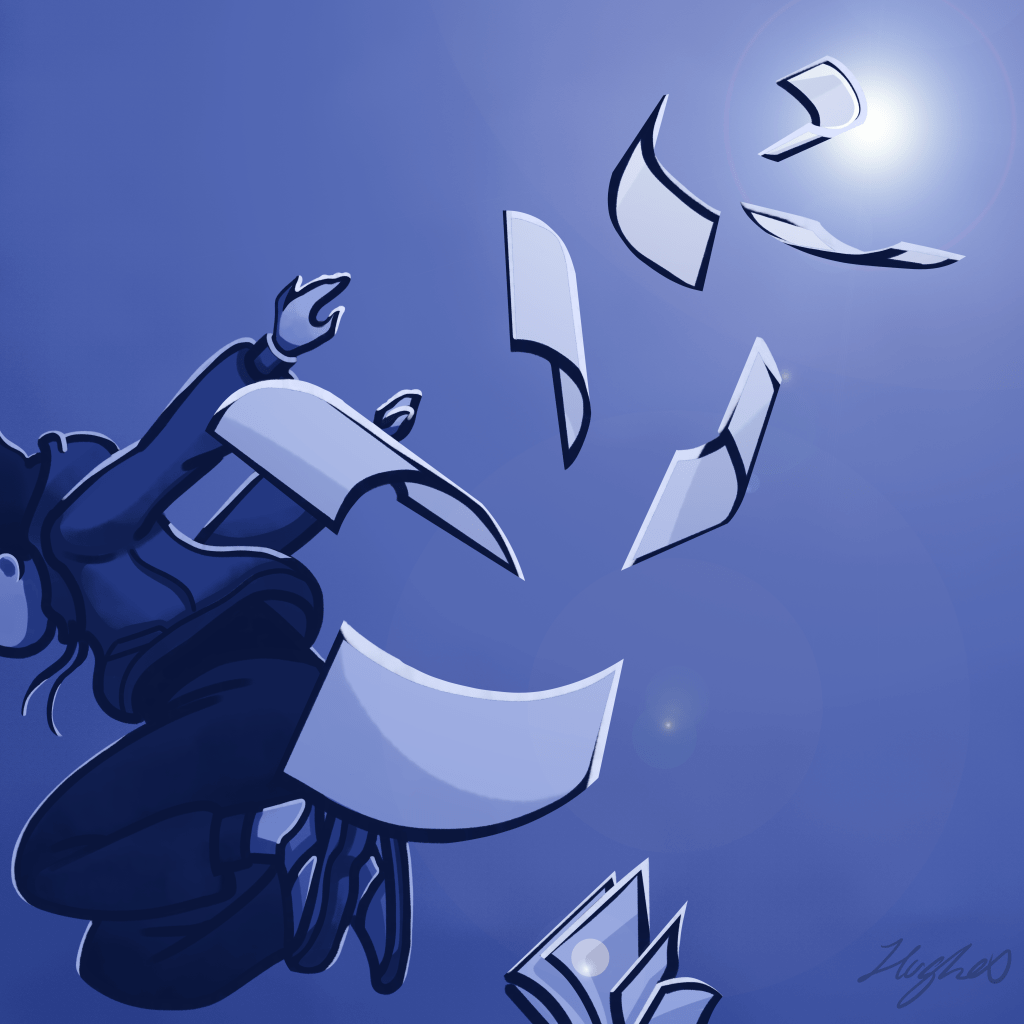
Air comes off the river, flying over the stone balustrade and striking my skin, fresh and cool. Small bumps conscript an army of vellus hairs across my arm and a rolling shiver flutters up my back. Something is about to happen. I have enough time to tense, before a force crushes my arm and knocks my armful of books over the side and into the water. A semester of notes, all gone.
“Hey!” I yell at the woman walking away along the balustrade. She’s stretching and rolling her taut shoulders, bound in tight synthetic fabric, as though she hasn’t just ruined my life.
When she doesn’t turn, I look to the water, smack the concrete with my hand, and set after her.
“Hey! What was that?!” I yell, en-route.
I saw her earlier, leaping around the bridges, statues, frontages, and roof-tops. Fun to watch, but I didn’t see what it was for. Must be some sort of sport, albiet a lonely one; the sun is missing in action and no-one else is exercising out here.
She’s sizing up a bridge when I reach her. It’s a bumpy arch of steel, and she’s spoilt for handholds.
“What was that?” I say, but she doesn’t turn, instead reaching for the metal.
I put my hand on her shoulder and she flinches.
“You knocked my notes into the water. That’s a whole term’s worth of five papers. And it’s two weeks before exams,” I say, feeling the heat in my face.
She stands still, facing away from me, not replying, and I don’t know what to do. What did I want out of this? She raises her hand to mine, lifting it off her shoulder but not letting it fall, while turning. And then her eyes catch mine. Something in them is afraid but hungry, while the rest of her face, around those portals, shows nothing but shock.
“Uh,” I say, withdrawing my hand from her grasp, “Would—”
“You’re real,” she says, backing away and pressing up against the bridge.
“Wha—” I start, but she’s already away, swarming up the bridge and once at the top, running across, leaping to a rooftop, and disappearing from view.
“Now, see here. The afferent arteriole … the heart to the … while the efferent … returns it. The bowman’s … filters … nephron … bladder … urine…”
I borrowed someone else’s notes and copied them at the library, running a small fortune through a machine. It took hours, jammed three times, and afterwards gave me words that seemed both sparse and dense, recording everything that I remembered but leaving great empty voids, things I am sure that I have forgotten. Now, in the penultimate lecture for this course, I just can’t seem to care. Words drift through the air, but I don’t put them together. It just doesn’t matter any more.
When the lecturer finishes speaking, I blink. Everyone stands to leave, but their faces are out of focus. If I concentrate, I can make out eyes, mouths, and noses, but even then I can see the edges around these pieces like a jigsaw puzzle.
“Hey, Germain,” something says. “Are you in there?” they follow, and everything drifts back to normality.
Sophia waves her hand in front of my eyes. Her face is normal, dark eyes and hair.
“Hey, sorry, I was up late. Took forever to copy these,” I poke my pile of loose papers, and start to shape them into a stack.
“I bet. Those are copies of my notes, I know just how long they are,” she says, hefting a binder. “Are you coming to lunch? We’re going to the hole.”
“Sure.”
The hole is a small beacon of light set in the base of a stone wall. They sell cheap sandwiches. With the loan I’m building, I’m technically poorer than most. The Hole makes things a little more bearable, and runs with a university subsidy.
“Bacon, cranberry, and cheese, thanks,” Alvin says, before handing over coins, collecting his sandwich and stepping aside.
Sophia, Anton, and Camille all go next, and then I’m at the front of the line. The cabinet is golden, and full of soft rolls, hard rolls, and croissant, all stuffed with meat of mixed origin, cheese, and greens.
“Ham and tomato, please,” I say, and hand over my coins, silver and gold.
The older woman collects the money and retrieves my sandwich. As she passes it over the counter, her face smiles and ceases to exist. The features are still there, and the arrangement, but it’s no longer a face. I feel my heart rate rise, and I freeze and close my eyes.
“Are you all right, dear?” I hear, after a moment.
I open my eyes, and force an expression but the woman is again normal.
The others leave, late for a class I don’t take, and I sit alone on a steel chair at a small table. A few pigeons bob and strut around, picking up the crumbs I flick their way. I only ate half the sandwich before it seemed less like bread and more like plastic.
The thought comes to me before I can stop it: I’m having some sort of breakdown.
I shiver. I can’t afford a breakdown. This is my first year in the course. If I don’t hit the top percent I won’t move onto second year; I’ll be stuck doing a repeat, or will have to change to another degree, and hope for post-graduate entry. A three-year setback.
I throw the last piece to the birds and look up. The main lunch crowd is coming along now, leaving lectures as my friends enter one. A line forms in front of the hole, down the way, and I need to leave my seat so someone else can have the table. I look at the line and study the faces: all normal. I shrug, stand, and walk. As I pass the hole, I see a someone walk astride the line. In a few moments they’ve hopped the counter, taken a stuffed croissant, and jumped back over. But no-one says or does anything. The woman behind the till works around them, and those in line stay there. When the figure passes the end of the queue, I recognise the her. This time, wrapped in thick woollen clothes, with a scarf around her neck.
Her gaze meets mine, and again she freezes, eyes wide. Then they narrow, and she stares at me.
“What is your name?” She says, not letting my eyes escape.
“Germain. What’s yours?”
She cocks her head and considers me, finally letting her gaze move away from mine, travelling up and down my face and body
“Call me Ohfei,” she says.
“Ohfei?”
“All correct,” she says with a small smile, before turning away.
“You knocked my notes into the river. When you stood on my arm the other day. Why?” I ask.
She looks back at me and makes a face, her mouth chewing over words.
“I— I’m sorry. I didn’t know,” she says.
“Know what?”
“That you are real.”
She sets off at a jog, and I watch her disappear around a corner.
I sit down at the desk with my clutch of ballpoints, a pencil, eraser, and sharpener. On one side of the surface is a staunch booklet and on the other, a thin sheath of lined paper. The first question isn’t too bad, it’s similar to those I practised on, and an answer begins to form as my hand moves across the page. I bullet some points, and then move the sheet to the side, taking another to write my full-length answer.
When I look up to ask for more paper, the world has changed. At first people would lose their definition: faces faded, or split into shapes, and materials gained a counterfeit lustre, a sham sheen that rendered things as plastic. Now, things mostly kept their reality. When I look up from my papers, the examiner looks normal enough, but I still know that they’re an automaton. They all are. Three hundred clockwork dummies whir and sputter around me; their flesh appears real enough, but their spirits are hollow.
After three hours I close the papers. I hand them to the examiner and I leave.
“Sophia, I’m going crazy,” I say.
To my relief, her hand on mine feels warm and genuine, and when I meet her eyes, their soft concern lightens my chest.
“How so?” she asks, a pause between words.
“Sometimes people seem fake. Like moving statues.”
She leans back and considers me for a few moments.
“You have some sort de-realisation? Huh,” Sophia says, brow knit.
“What?”
“I haven’t noticed anything. You seem pretty normal.”
This should comfort me, but for some reason it doesn’t. If I were going insane, I want it to be obvious. Treatable.
“Is this some sort of stress response? Maybe you’ve been too worried about the exams…” she says.
“Maybe you’re right,” I reply, “Losing my notes has made it awful…”
The memory of my notes tightens my chest as Sophia lets out a small laugh.
“I bet. But you’re done with exams now, right? We have a few weeks before next semester and your results. And we have Alyssa’s party tonight, you’ll have a chance to breathe.”
I nod, and Sophia grasps my hand again.
“But if it keeps up, you need to see a doctor. Someone who’s au-fait—”
My chest tightens again.
I stand as Sophia does, and we walk away. She tells me what she is going to wear to the party, but I don’t hear her. I am busy, struck by the memory of Ohfei knocking my notes into the river, and calling me real.
The house is bursting with flesh. Every room stuffed with sweaty, loud, squirming masses of bodies writhing to a thumping pulse of sound that hurts my ears from a block away. After arrival, I lose Sophia immediately, and Alvin with Anton soon after. But I don’t care. I’m not sober. I’m in the middle of the mass. I’m moving to the music. I’m thinking of nothing else and caring for nothing but the moment. Everything seems right.
The jockey bounces the sound from a drop, sandwiches a melancholy note, and transitions to a new number. The decade prior was overfilled with synthetic sound, and so the music of today is the opposite: raw, stripped, and acoustic. Somehow, it still works in the setting— a testament to the jockey. My body moves on its own, each beat and tone like a hand above, drawing my limbs out and in like a mannequin, shifting my shoulders and my torso, throwing my head around.
And then there’s another in my space. Same age, with a cute face and tight clothes. Her smile catches me and I can’t slide off the hook. We’re dancing together, her puppeteer conspiring with mine. When the music changes, she takes my hand and guides me away from the masses. We slink through the crowds and up the staircases. She swipes a key from the lintel and opens a door, sealing it after we pass through.
Chess is a zero sum game. Each piece taken is an advantage gained, and each piece lost is a sinking dread. When one side wins, the game is over, and the other side loses. But not all games are zero-sum. The best aren’t. During our game, the worst happens, again. I see the edges to the puzzle, and the sensation from my skin is a lie. The automaton wins, and I concede.
I sit on the curb outside in the cold, music and light to my back, sick in my throat. It’s not stress. Or, if it is, the damage is too deep. I need help. The world is a box and the people in it aren’t real.
The next morning, I set out to find her. It’s clear that she started this, that I contracted something from her when she knocked my notes into the river. She must be deep in our shared sickness, if everyone seems unreal, and no-one notices her jumping lines and stealing food. If anyone knew what was happening, it must be her. I start at the river by the university, with its bridges, statues, and old buildings. She isn’t there, and thick sheets of rain drive me away. The hole is closed, so I rule it out. Where else would she be? Where would I go, if I thought everyone were fake, and no-one stopped me?
I go through the galleries, the observatory, the libraries, emptying my pockets for entry fees and transit. But it’s all bust. I’m on the wrong track and in a city of millions, there are a lot of trains. Maybe she’s left, walked aboard an aeroplane without a ticket, and gone away to visit somewhere new. If she has, I’ll never find her.
By the second week of searching, my symptoms have stabilised. Objects seems real enough, buildings and places and food are material; the weather as hungry for my skin as ever. But the people are all finished. The automata around me now move as though I don’t exist. When I concentrate, I can make out the words and understand the emotion they carry. But it isn’t easy. I live as she must, in a world of clockwork toys animated by a dull mind.
When the door clicks shut behind me, I know that I’m in trouble. I am exploring and followed an automaton in, but they have left and now the door is locked. I’m in a vault, in the old bank in the centre of the city. The individual boxes are locked and yield nothing of interest.
When the vault door opens again, I nearly crawl out. I have no way of knowing how long it has been, but I slept three times, violated a corner, and desperately need water.
I eventually take the keys and a car from the lot, and drive away. Refuelling is easy: I go behind the counter, watch the attendant, and then mimic them, activating all of the pumps and replenishing my supply. I move around in ever-widening circles, visiting the nearby sights, searching. At this point, I’ve almost given up on her. I staked the university for over a week, and saw nothing. She moved on, and I lost my chance. So now I’m looking for something else.
My net widens. I do as I think she must, boarding and exiting craft at will. I go somewhere warm, and cruise through the crowds of automata. I take some pleasure in the waters and swim, but when I pay close attention to the fishes, I can only see their mechanical hearts and engineered gills. I go somewhere temperate, and try the glittering lights and dizzying heights of a larger built environment, but it is the emptiest place of all, and only hurts. I try somewhere cold, and isolated. A frigid wasteland with five brightly coloured buildings under a demanding sky. But sub-freezing temperatures bring no comfort, and after I’ve worked through their library, I have nothing.
I return to civilisation, as it is. On my first real flight, full of bodies, I enter the cockpit and push a lever down, overriding the automata beside me. I feel the forces move my body, but it doesn’t stir me. I let go, and return to my seat. In the following weeks and months, I find shady places and raid hospitals, trying things I shouldn’t. Medicine works on me as it does the automata, but I find no lasting pleasure.
When I return to the city, I head for the university riverside. It’s summer now, and the sun beats viciously, heat rising from the paved streets and radiating from the old walls. I arrive at the river, and after a moment, mount the balustrade. I look down at the water, and I fall in. The water is clear, unusually so, and its cool touch is refreshing. I empty my lungs and sink. In the river’s grasp, at the bottom, my hands find purchase, clutching something stuck in the muck and tangled in the weeds. My fingers trace the surface, and the texture seems familiar. The cover for my notes.
I wake to fire in my lungs and a deep ache in my tissues. The evil glare of the sun hurts, and it mocks me when I sit up and hack up an ocean. When I’m finished, a slap on the back strike me like thunder.
“That must have been your first time trying, huh? It won’t work. It never does. Hurts, though. Always hurts.”
I launch into another round of coughing.
The mechanical pigeons peck at my sandwich more than I do, sitting on the steel chair at the small table down from the hole. Ohfei looks at me, her own lunch long gone.
“Do you blame me?” she asks.
I look at her.
“For ruining my life?”
She nods, and I consider the question.
“I don’t know,” I say, chewing the words. “It started with you. I was normal before.”
She nods, and taps her fingers on the table.
“I didn’t do anything intentionally. I wouldn’t wish this on anyone. That’s why I tried to avoid you. I hoped you’d go back.”
“How did it start for you?”
She scratches her arm, and looks away.
“Would it be strange if I said that I don’t remember?” she says.
I shrug.
“Well, I don’t. I woke up here, seemingly in a life made for me. I followed the maps and timetables in a room full of things I like. I worked hard, trying to listen to them, to learn, to live. They started off like us. But after awhile, I gave up, and they all faded to golem”
She shrugs.
“So I dumped the life made for me. Travelled. Did things I shouldn’t, and tried to die a few times. After, I found things to do. Mostly reading and parkour, hikes, now and then.”
“Parkour. That’s the jumping. The climbing. The standing on my arm and knocking my notes into the water.”
She nods.
“Sorry about that. I’ve touched plenty of golem, I have never seen one become real, never had one touch me back,” she says, making a face. “What about you? You were one, you must have had friends, a family. What was your golem life?”
I search, and all I seem to strike are hollow balls or blanks.
“I had friends. I don’t remember family. I was here to learn. I wanted to be a doctor.”
She nods.
“Sounds a little like me, it just took you longer to see the lines. I wanted to be an engineer, to make rockets,” she says, then laughs. “I sneaked aboard one, once. I regret the full stomach, and not checking the schedule. It was three months before I could make it back down again, crammed into a tiny steel ball with two golem.”
“How long have you been like this?” I ask, dreading the reply.
She cocks her head.
“I don’t know. What year is it?”
I open my mouth but find I can’t answer, and my expression drives one on her face.
“I thought so. Whoever’s made this place for us did half a job,” she laughs. “But with you here, it seems less likely to be my own fault. I’ve worried about that for a long time.”
“You fault for what?”
She takes my hand, rubs it with her fingers.
“Everything. I thought I made this all, trapped myself here. I thought I was the only real thing in existence.”
I feel something loosen in my chest.
“I’ve felt the same.”
We sit long enough for the clouds to draw over the sun, and for the birds to lose interest, taking time to recover from the exhaustion from speech after so long in silence.
Long after the birds lose interest, I voice the question that’s been building in my mind for hours: “What do we do about it?”
We’ve suborned a lecture theatre, a disused one Ohfei found long ago, with a large chalkboard. We cover it in other ideas, and eventually return to the inevitable subject. It seems important to voice what we’ve experienced. I add drowning, various chemicals, and cold to the list as she compiles it.
“Not too many, that’s good,” she says, “Not too much extra suffering.”
“Blood loss, tissue loss, rope, poison, electricity, altitude. No vacuum?”
She shakes her head.
“I didn’t see how I could recover from it. I’m not brave enough to try re-entry.”
I take her hand, squeeze it, and she returns a small smile. Time to move on.
We write a hierarchy of falsity. At the top are the automata, the golem, which require immense concentration to seem real. Below are animals, which are real at a glance. Next, Ohfei places other living things like plants, and microbes, which she tells me seem real except for very close study. Finally, there are dead things like buildings, rock, and energy. We crank the heaters to fight the real cold, coming with the darkness.
Later, we take a break, and Ohfei leads me away. In another building, she reaches behind a heater to produce a spare key, and unlocks the university’s staff club. In the refrigerator are containers of soup, and in the larder are loaves of bread, which she heats and toasts as I set a table.
“The coffee machine is good, but temperamental,” she says, after finishing her bowl. “First thing tomorrow, I’ll show you how to use it.”
I nod, chew, and swallow some toast.
“You think we’re going to need a lot of caffeine?”
She laughs.
“So much.”
Day two has us move onto a second chalkboard, where we write up bits and pieces of our remembered lives. I add the names of my friends, the address of my dorm, and my career plans, while Ohfei writes up her own parts.
“Both important jobs. Doctor and Engineer,” she says, wiping the dust from her hands. “What or whoever made this place wanted us qualified.”
I nod and point at her list of friends.
“Four companions, two men and two women. Sophia was kind, fun, and terrible at classes. Alvin was active, and funny. Camille was quiet, beat me in tests, but never did anything else. Anton tried everything, and always spoke up when I did something wrong. How were—”
“My friends were exactly the same,” Ohfei says, bobbing her head. “A mix of smart, fun, active, and kind. I got about that much from them before it all fell away.”
“Put us in training, and give us a support network,” I say, before moving forward to write it up.
Ohfei takes another piece of chalk, underlines my words, then steps back.
“Someone made all this for us to get those degrees. They must need a doctor and an engineer.”
“Maybe that’s the trick. We get the degrees, and we get out.”
She scratches her cheek.
“How do we do that when everyone is a— you call them automata?”
I nod, and grimace. An idea blooms, an idea that grieves me.
“You can hear them when you concentrate, right?” I ask.
“Sure, so?”
“You’d better show me how to use that espresso machine.”
Finding words in the noise demands practise, and the first day is difficult. From early morning to early evening we spend almost all hours in theatres, with the sporadic empty spaces filled by tutorials. In the evening, we find some take-out and eat in front of the blackboards, chalk staring us down.
“Thoughts?” I ask, over a forkful.
She grimaces around her food.
“Hard. It’s been so long, I can hardly even understand them anymore.”
I nod at a timeline scrawled along the board. We added it last, and had to smear other words away for the line to fit, so the figure rests on a haze.
“Do you think we’ll be on target for stage two?”
She considers the board and half shakes her head.
“I don’t know.”
I spent more time as one of them, or at least remember as such, and reintegrating is easier for me. After a few weeks of classes, my familiarity with the routine hits, and I can make out more from the din. But it’s been a long time since Ohfei sat down and engaged with the automata.
We have to move the date back several times, but eventually Ohfei and I are both ready for stage two. Ready to stop looking at the gaps.
She calls heads, but it lands on tails, so she leads. A few streets back from the river, I stand by a door as she enters a code right on the first try, then pushes the timber inwards. We scale a rickety staircase to the third floor, and she swipes a key taped resting behind a radiator, using it to open a narrow door numbered eight.
The room is small, with a single bed and drawers, desk, chair, and wardrobe. She opens the curtains and after a few blinks I see the winding street below.
“Would you look at that?” Ohfei says, with sad smile, “It’s still alive.”
She points to a fern in the corner.
“Huh. That’s good. That’s really good.”
We stand there in silence until the sun passes behind a cloud.
“Your turn,” she says.
So we leave, crossing the river, crossing the campus, and arriving at a flat wedged between two larger buildings. I stand on the step and look at the door.
“Hey, it’s OK,” she says after a moment.
I nod and take the spare from under the mat, and open the front door. In the hall, we pass an automata dusting.
It’s Sophia.
I can see her face, read her eyes, and understand her expression. She smiles at me, smiles at Ohfei.
“Hey Soph, this is Ohfei,” I say, giddy at how the words fall from my mouth so easily.
“Oh, looks like I finally get to meet her. Hey, gorgeous, why are you with this idiot?” Sophia says to Ohfei, a wide smile on her face.
“Gotta start somewhere,” Ohfei manages, after a moment, with a small smile of her own.
Sophia nods, then looks at me again.
“Someone dropped your letter in a puddle, so I fished it out and dried it on the heater. Saw the words, sorry about that. But congratulations!”
“Congratulations?” I ask.
“On your exam results.”
Air comes off the river, flying over the stone balustrade and striking my skin, fresh and cool. Small bumps conscript an army of vellus hairs across my arm and a rolling shiver flutters up my back. Something is about to happen. I have enough time to relax, as a hand rests on my shoulder.
“What now, Doctor Germaine?” she asks.
“I have the paper,” I say, “And the funny hat. But nothing seems that much different. How about you, Doctor Ohfei?”
She shrugs, and we both look at the river.
“We did it,” she says.
“We did,” I reply.
A gaggle of people drift pass us, in their own regalia. It takes constant effort, but after years I know how to ignore their seams.
“What next?” Ohfei asks.
I feel the breeze flutter against my gown.
“Keep going, I guess. If something or someone wants us qualified, a degree is a start…”
She taps the concrete.
“So now we need experience. The stage four we hoped to avoid,” she concludes.
I nod.
“Well, good thing I got the job at ESA” she says after a moment, and my heart skips as she grins.
When our pod splashes down in the pacific, I can finally relax. It’s clear that everyone is healthy, and with that, there is little for me to do until collection. I unbuckle and move over to Ohfei, who is inspecting a series of readouts on her display. The swell is mild, but present, and even with the workouts, moving is harder than I hoped. I have some pain in my joints and back, and I feel heavy.
“Is that good?” I ask, pointing at a number in red.
She shrugs.
“A little hot, but in tolerance. Might ask them to take a look at it before next launch.”
“Not going to report it now?”
She rolls her eyes.
“Shouldn’t you be planning our holiday?” she fires back. “Next launch window isn’t for ages, even if they want old bones like us.”
I drop my voice.
“Well, it’s not like they could stop us anyway.”
She looks at me, and I dip my head.
“Yeah, fair call. Not funny. Did we decide on where—”
I stop when I see her eyes. They’re open wide, and inside I see panic.
“What?”
“Where are the others?” she asks, with deliberate care.
I look around and see no-one. We spent three months in orbit, quarantined with a gradually increasing spin, and at half gravity the pod launched to earth crewed by fifteen. Now it’s just us in the machine.
“Fei,” I say, “I think it’s finally happened. Let’s pop the top.”
The door is meant to stay closed until we’re dragged aboard the recovery vessel. But everything has overrides, and Ohfei is an engineer with two decades of field experience and five missions under her belt. She has it open in ten seconds.
She pulls herself out, and helps me up. The light is strong, much brighter than in the pod, and I spend a few moments in a squat, adjusting. When I do, I realise that the swell is gone. So too is the sea, the sky, and somehow, the pod. Ohfei and I are alone in a pale grey void.
And then a man appears. He is young, dark, and bald, his white teeth a beacon of contrast.
“We were worried. Never seen someone get so off track before,” he says, with a cool tone, reaching to shake Ohfei’s hand.
She accepts, and then it’s my turn. His skin is cool, but not cold.
“They told me it wouldn’t work, but I knew you’d do well,” he says, now looking at me. “Your numbers work too well with hers, not to. I have requested that you be paired for the next run.”
Ohfei and I look at each other, and she beats me to the punch.
“Next run?”
The man nods.
“Half a lifetime as Engineer and Doctor, both with field training. It’s a good start, and you did well. But we need more than that for the programme. I was thinking navigations and psych, next. Probably set a century on from what you know. Are you ready?”
I take Ohfei’s hand.
“What programme?” she asks, eyes slightly narrowed.
The man smiles.
“An exploration, further than anyone has gone before. That’s all I will say.”
I look to Ohfei and she shrugs, before eyeing the man.
“Will we remember this?” she asks.
“Not until the end.”
“Can you keep us on track? I don’t want to see the lines again,” I ask.
He looks at me.
“If you do, I think you will figure it out. Goodbye, I’ll see you ahead.”


Leave a Reply